



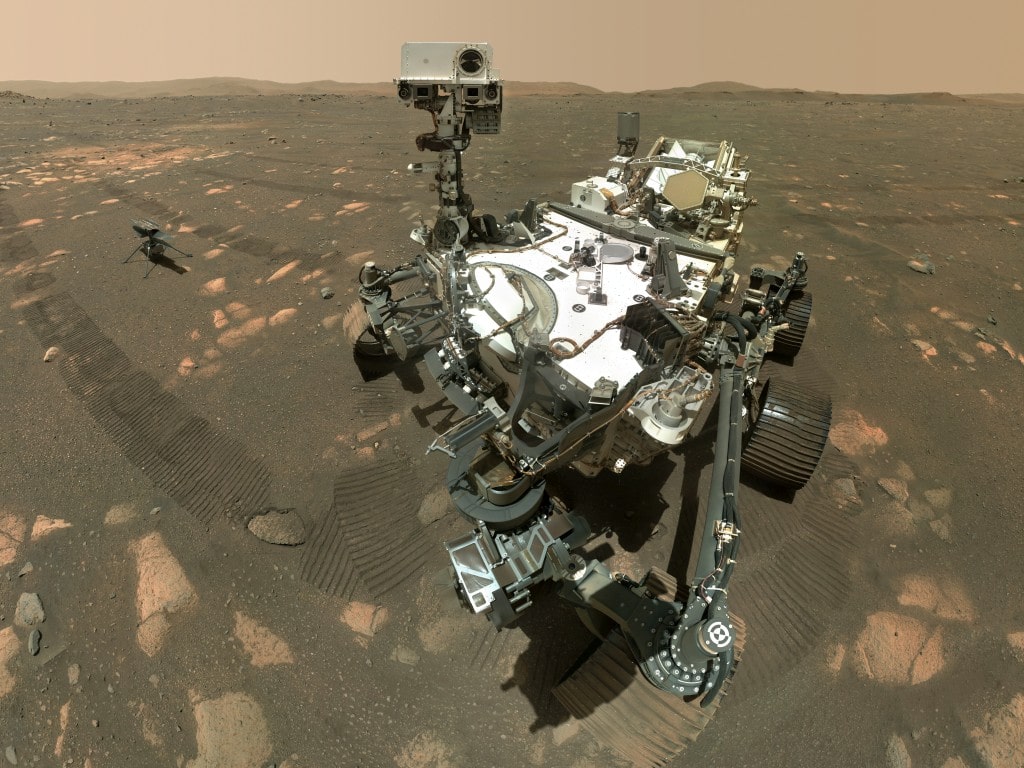

NASA’s Perseverance rover, which has been exploring the Jezero crater on Mars since 2021 has just logged 26 miles of total travel, the equivalent of a marathon. This crater was chosen as the destination for the rover, with its advanced sensing instruments, because at one end there is a clear river delta and the crater itself was at one time believed to be under water. And indeed, as the rover has explored the terrain, it continues to gather more and more evidence that the red planet had a much more watery past.
Today, Mars has a very thin atmosphere (your first deep breath would be your last deep breath) and water can only exist there as water vapor or frozen ice. When the air pressure is really low and nothing presses on them, water molecules tend to fly apart as gas. But astronomers know that billions of years ago, Mars had a much thicker atmosphere and ample pressure to keep water liquid. Indeed, we see evidence of dry river beds and lake beds from that era. Because Mars is a smaller planet than Earth, its gravity was not able to hold onto to its air, and the atmosphere slowly “jiggled away” into space.
Luckily, it also meant that the atmosphere was not able to keep Mars warm (no greenhouse effect) and the surface got cooler and cooler. Therefore, much of the water on Mars froze solid before it could leave the planet. We see great sheets of frozen water in Mars’ polar caps, and increasing evidence — from space and from the surface — of many more ice deposits below the martian surface layers. And, the shapes of the rocks and the surface chemistry in Jezero crater have, in the last five years, filled in more evidence of how ancient Mars was wetter and warmer.
Now bear in mind, life on Earth began in our oceans when our planets was wet and warm. Naturally, it occurs to astronomers to ask, could some form of primitive life have formed on Mars before the planet lost so much of its atmosphere? And if it did, could some of that life be frozen into the ancient martian ice?
On Earth, scientists have “defrosted” older life forms that were frozen into ice deposits on our planet. Naturally, we wonder if someday, we might do that on Mars.
This is why I wrote a short science-fiction story a while ago that was published under the title “I Swallowed a Martian,” which takes up this theme. You can read it free at: http://bit.ly/swallowedmartian
I hope you enjoy it.
Related Posts
Astronomers around the world have been observing a small but fast object that gives every indication of coming …
By a cosmic coincidence, the first day of 2018 will have a nice full Moon …
On Wednesday morning, January 31, residents of North America (and particularly those on the west coast) will experience …