


• MY BLOG
  • BOOKS & ARTICLES
    • Books by Andrew Fraknoi
    • Articles for the Public
    • Articles for Educators
    • Classroom Activities on Astronomy
  • RESOURCE GUIDES
  • CONSULTING
    • Non-technical Talks on Astronomy
    • Developing Resource Guides
    • Writing Web-based Articles
    • Giving Talks on Astronomy Education
  • CLASSES & LECTURES
    • Classes I Teach
    • Silicon Valley Astronomy Lecture Series
    • Public Lectures I Give
  • GALLERIES
    • Solar System Images
    • Nebula and Galaxy Images
    • Bumper Stickers for Astronomy
    • Pictures with Astronomers
  • AUDIO & VIDEO
    • Radio Programs & Podcasts with Andrew Fraknoi
    • Videos of Talks and Interviews
  • SCIENCE FICTION
Type and hit ENTER

Be Yourself. Be Happy.

Of the grand order of folio leviathans, the Sperm Whale and the Right Whale are by far the most noteworthy. They are the only whales regularly hunted by man. To the Nantucketer, they present the two extremes of all the known varieties of the whale. As the external difference between them is mainly observable in their heads; and as a head of each is this moment hanging from the Pequod's side.

Stay Positive. Always.

Of the grand order of folio leviathans, the Sperm Whale and the Right Whale are by far the most noteworthy. They are the only whales regularly hunted by man. To the Nantucketer, they present the two extremes of all the known varieties of the whale. As the external difference between them is mainly observable in their heads; and as a head of each is this moment hanging from the Pequod's side.

  • MY BLOG
  • BOOKS & ARTICLES
    • Books by Andrew Fraknoi
    • Articles for the Public
    • Articles for Educators
    • Classroom Activities on Astronomy
  • RESOURCE GUIDES
  • CONSULTING
    • Non-technical Talks on Astronomy
    • Developing Resource Guides
    • Writing Web-based Articles
    • Giving Talks on Astronomy Education
  • CLASSES & LECTURES
    • Classes I Teach
    • Silicon Valley Astronomy Lecture Series
    • Public Lectures I Give
  • GALLERY
  • AUDIO & VIDEO
    • Radio Programs & Podcasts with Andrew Fraknoi
    • Videos of Talks and Interviews
  • SCIENCE FICTION
GET CONNECTED
  • MY BLOG
  • BOOKS & ARTICLES
    • Books by Andrew Fraknoi
    • Articles for the Public
    • Articles for Educators
    • Interdisciplinary Articles (Astronomy & the Humanities)
    • Classroom Activities on Astronomy
  • RESOURCE GUIDES
  • CONSULTING
    • Non-technical Talks on Astronomy
    • Developing Resource Guides
    • Writing Web-based Articles
    • Giving Talks on Astronomy Education
    • Organizing Conferences or Workshops
  • CLASSES & LECTURES
    • Classes I Teach
    • Silicon Valley Astronomy Lecture Series
    • Public Lectures I Give
  • GALLERIES
    • Solar System Images
    • Nebula and Galaxy Images
    • Bumper Stickers for Astronomy
    • Pictures with Astronomers
  • AUDIO & VIDEO
    • Radio Programs & Podcasts with Andrew Fraknoi
    • Videos of Talks and Interviews
  • SCIENCE FICTION
Webb Telescope Shows Glittering, Massive Cluster of Galaxies
Share
Astronomy, Galaxies, Gravitational Lens, James Webb Space Telescope

Webb Telescope Shows Glittering, Massive Cluster of Galaxies

January 23, 2026
-
Posted by Andrew Fraknoi

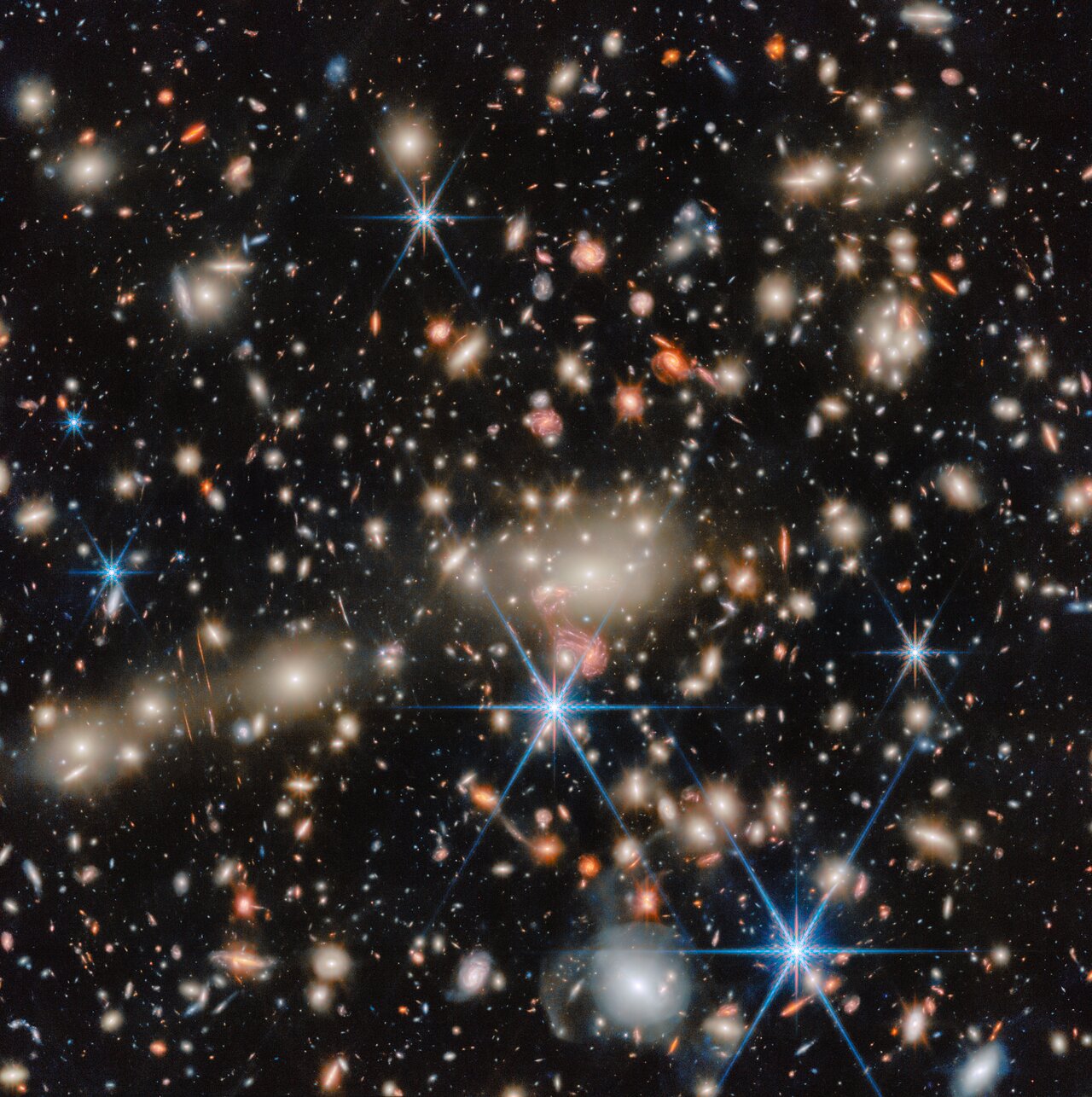
The James Webb Space Telescope continues to send us remarkable images and information.  I was struck by this beautiful image showing a huge cluster of galaxies about 5 billion light-years away. (That means the light we see here left those galaxies 5 billion years ago, when the Sun and the Earth were just being born in our Galaxy.)  Yet look how clear and sharp the image is.  The bright stars with spikes are stars in our own Milky Way Galaxy which happen to lie in the same direction.   Everything else in the picture is a galaxy of millions or billions of stars.

Notice that some galaxies are larger and easier to make out, while others are smaller or further away.  Among the bigger images, you can distinguish some bluish-white galaxies that show spiral structure, similar to our Milky Way, and some yellowish, round galaxies that have the characteristic elliptical shape of galaxies with little internal structure.  But just let your eyes taken in the sheer number of different galaxies, and imagine the even vaster number of stars and planets which they contain.

The entire cluster contains at least 300 individual galaxies, and astronomers estimate that there may be a several hundred more galaxies in the same direction that are possible members. Their combined gravity is enough to warp space in the neighborhood and therefore to bend any light coming from galaxies behind them, something we call gravitational lensing. (This was predicted by Einstein from his general theory of relativity, and already found in many Hubble images.)  Astronomers can see several elongated and misshape structures in the image that are lensed background galaxies.

This cluster is too remote to have a name, but is denoted by its ugly catalog number  MACS J1149.  Still, isn’t it a gorgeous picture?

January 23, 2026

Related Posts

Other posts that you should not miss.
Asteroids, Astronomy, Comets

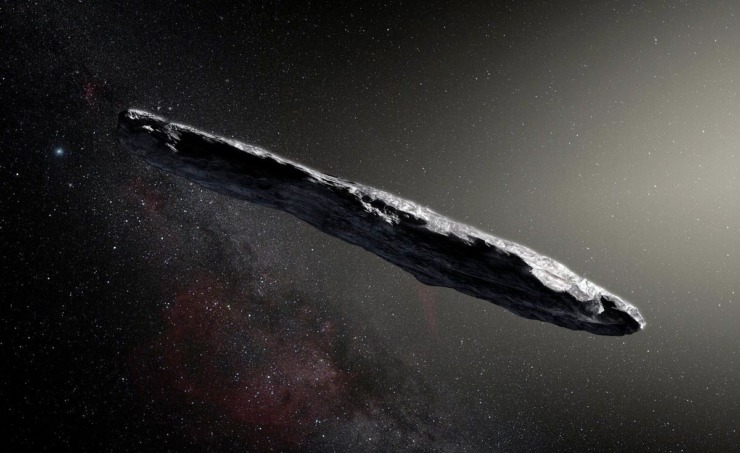
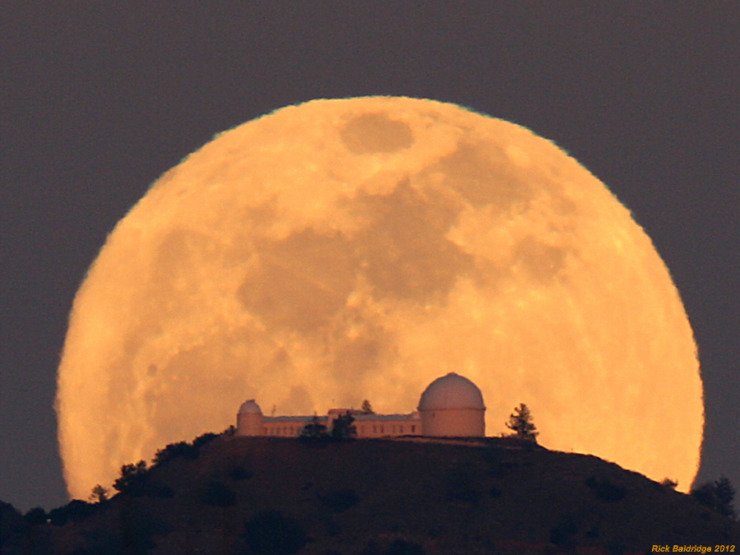
First Visitor from the Realm of the Stars Ever Found Is Oddly Shaped

December 6, 2017
-
Posted by Andrew Fraknoi

Astronomers around the world have been observing a small but fast object that gives every indication of coming …
Read More
December 6, 2017
Posted by Andrew Fraknoi
Full Moon, Lick Observatory
Astronomy, Moon, Sky Phenomena

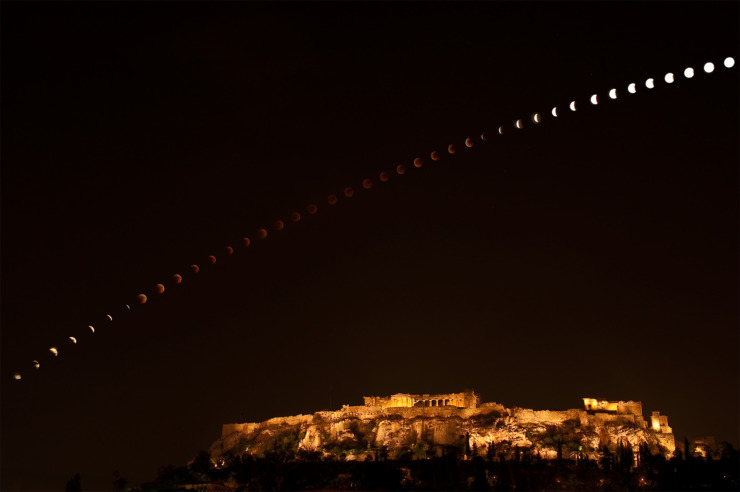
New Year’s Day Full Moon will be a “Supermoon”

December 30, 2017
-
Posted by Andrew Fraknoi

     By a cosmic coincidence, the first day of 2018 will have a nice full Moon …
Read More
December 30, 2017
Posted by Andrew Fraknoi
lunar eclipse, eclipse of the Moon,
Astronomy, Eclipse, Moon, Sky Phenomena

Total Eclipse of a Blue Supermoon on January 31

January 26, 2018
-
Posted by Andrew Fraknoi

On Wednesday morning, January 31, residents of North America (and particularly those on the west coast) will experience …

Read More
January 26, 2018
Posted by Andrew Fraknoi
NEXT POST →
What's Coming in the Sky in 2026?

"*" indicates required fields

This field is for validation purposes and should be left unchanged.

Subscribe to my blog!

Name*

RECENT POSTS
  • A total eclipse of the Moon
    What’s Coming in the Sky in 2026?
    January 10, 2026

    We review what's coming in the sky and in space exploration for 2026

  • Winter Solstice Arrives on Sunday Dec 21
    December 18, 2025

    Dec. 21 is the winter solstice. We explain what this means and how the seasons come about.

  • A Course Via Zoom on Atomic Science for Everyone
    September 20, 2025

    I am teaching a new Zoom course on the mysterious world of the atom, …

  • Logo for a 1-day meeting on the future of astronomy
    A 1-Day Virtual Symposium on Future of Astronomy
    August 7, 2025

    For those of you with a deeper interest in astronomy and how we learn …

  • Virgo Cluster (part) from the Rubin Observatory
    New Telescope to Take Movie of Entire Sky
    June 24, 2025

    Astronomers unveiled first pictures from the amazing Rubin Observatory, which is getting ready to take the deepest, widest movie of the entire sky.

Archives
  • HOME
  • ABOUT ME
  • CONTACT ME
  • FAVORITE LINKS

© Copyright 2025 | All Rights Reserved

Webb Telescope Shows Glittering, Massive Cluster of Galaxies