



I hope you are allowing the trip four humans are taking around the Moon to distract you a bit from all the problems we are facing down here on Earth!
Artemis II is mostly designed to test the engineering of the Orion spacecraft and all the systems that keep humans alive. The science-fiction writer in me is excited to see humans returning to space; the scientist in me knows that there is not much new science in this mission, but that’s OK. By the way, NASA is making a big deal about the fact that the astronauts will be farther from Earth than anyone before, but we are only talking about 4000 miles farther — out of some 250,000 miles, so it’s a pretty minor increment.
The astronauts do get go around and see the far side of the Moon. We only get to see the near side from Earth, because the Moon takes as long to go around the Earth as it takes to spin on its axis, so only one side faces us all the time. Try this with a family member to see what I mean: One person stands still in the middle, and another person starts by facing them, and then walks slowly around them, spinning (turning their shoulders) at the same rate as they walk around. The person in the middle will always be looking at the orbiting person’s face; never the back of their head.)
Robot probes have given us excellent images of the far side of the Moon, in much greater detail than the astronauts will see. But still, there is something exciting about the astronauts seeing the side we never see from Earth with their own eyes.
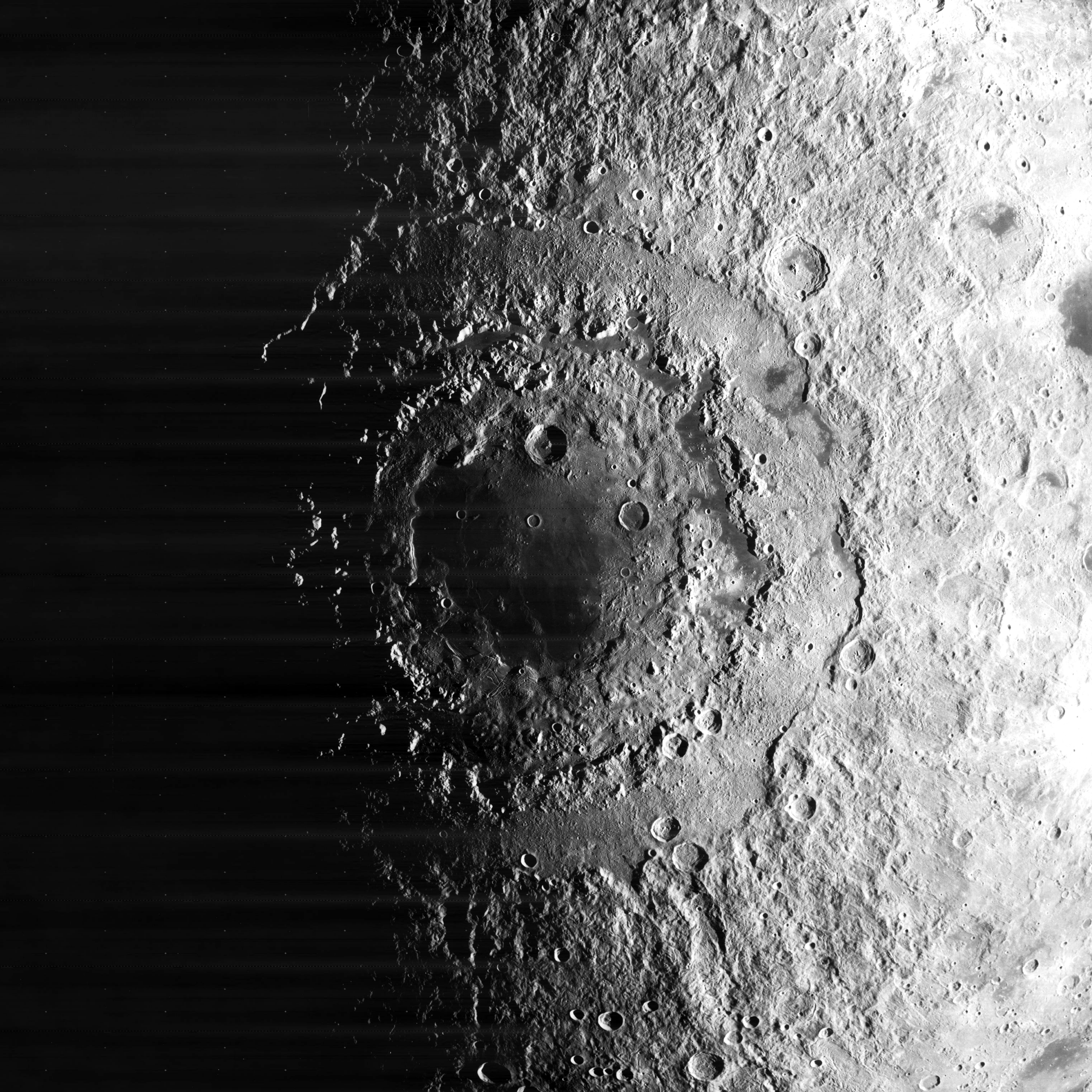
Perhaps the best “tourist attraction” on the far side is a giant impact crater called “Mare Orientale” (the Oriental Basin), which is some 600 miles across. In the center, dark lava welled up and covers the inner disk. Then rings of mountains (the ripples from the huge impact that melted the Moon’s crust) surround the central region. See our accompanying photo.
If this were on the near side of the Moon it would be visible on clear nights to the naked eye and would look like the Moon had a bloodshot eye. Imagine the legends ancient cultures would have come up with! Let’s see if the astronauts give it a shout-out.
Here’s hoping for a safe landing on Friday.
Related Posts
Astronomers around the world have been observing a small but fast object that gives every indication of coming …
By a cosmic coincidence, the first day of 2018 will have a nice full Moon …

On Wednesday morning, January 31, residents of North America (and particularly those on the west coast) will experience …